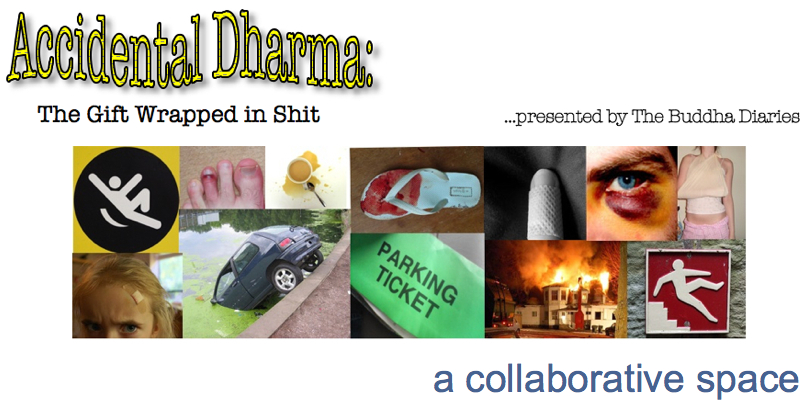
From Gary
at Forest Wisdom
Today I have a cold. It’s not a terrible, debilitating one, when one can’t get up because there’s no fuel in the tank, and it obviously isn’t preventing me from doing stuff such as working on my computer. Yet, it is unpleasant. In Buddhist terms, it’s revealing that life is dukkha, (unsatisfactory, imperfect, suffering). This isn’t an excuse to wallow in my own little corner of self-pity, however, bemoaning my fate and cursing the gods for this affliction. As well as being an example of dukkha, it is also impermanent (anicca) by its very nature; it will not last.
Ajahn Sumedho has commented that having a cold can be an opportunity for reflection, for developing some wisdom. As he’s said, colds happen to us as a result of being born as a human, and that contemplating thus is reflecting on the way things are (Dhamma). Such a consideration is not a judgment, nor is it blaming anyone for giving one a cold – it’s not taking it personally.
Luang Por Sumedho has made an insightful observation here, that current experience, whether pleasant or unpleasant, is a chance to awaken to reality, to Dhamma. So, as I sit here with the usual symptoms of the common cold, reflecting how it’s part and parcel of being human, I’m becoming awake to the fact that every time I sneeze, it’s an opportunity to consider the Dhamma, rather than simply complaining about it. Achoo!
Sunday, January 27, 2008

Friday, January 25, 2008
A Treasure
by Peter Clothier
The Buddha Diaries
(Cardozo picked this one out for me, going through the Buddha Diaries archives... It was first posted February 20, 2007.)
I broke a treasure this morning. My daily routine is to come upstairs after my morning meditation (our bedroom, in this house, is on the lower level) and make a pot of tea to bring down for us both to enjoy in bed as we watch the morning news. This morning, in the process of assembling things on the tray, I reached for the sweetener and knocked its container off the shelf to the floor. The container in question was the smallest in a set of three ceramic "Made in Japan" cannisters--a gift, Ellie reminded me later--from a friend who had been a house guest in our home at a difficult moment in her life. We have a whole collection of these things, accumulated during our swap-meet days, but this one was of a particularly attractive, post-deco design and had been much used and loved.
I was feeling a bit sad and guilty, then, when I broke the news to Ellie. I could take the event, I suppose, as an object-lesson in non-attachment: no matter how much we treasure them, things come and go in our lives and it's best not to attach too much significance to their arrival--or their loss. This was a small thing, indeed. There are much bigger, much more important things we are called upon to relinquish--up to and including the very bodies in which we spend our lives!--so I can't feel too sorry for myself over the loss of what is clearly no more than a trinket, no matter how beautiful we thought it. It's important, though, to take note of that twinge of sadness and regret over something so small, and realize how easily we do become attached.
My choice, though, is to look at it also from another point of view. What caused the loss was a moment of inattention on my part--a lapse that only became significant when its result became apparent. There's something bigger at stake here. In the course of my morning sit, I had become more than usually aware of extra weight I carry around with me with a discomfort that I am normally able to ignore. I know that this, too, is just another result of inattention, the mindless consumption of unneeded food and drink for no better reason than emotional consolation. Since I have been thinking a good deal about karma these past few days, in both conscious and, I'm sure, unconscious ways, I began to see plausible connections between past actions and my present predicament.
The uncomfortable truth is that I do not need to explore my past lives--if such there were--to find examples of the kind of unskillful, harm-producing actions that could result in my need for emotional comfort today. No need, here, for personal confessions. The nature of those past actions matters less than the realization that they could have resulted in those things about myself that I find less than appealing today and would like to change. To wit, for one, that extra weight I carry around with me to my discomfort and to the detriment of my health.
The realization, of course, is a good deal easier than the choice to become more mindful, more attentive to what I put into my body. Wisdom is cheap. Those things I love, to which I have become attached--my extra glass of wine, my pre-dinner snacks, my post-dinner desserts--seem to mean more to me than health and balance in my life. The good news is that this is not one of those things that can't be changed, that can be addressed only with equanimity. But I guess that's the bad news, too, because it makes it my responsibility to change. It's not that I don't know what's good for me. No. It's that I persist in making choices for the bad. As countless others have discovered before me, there is no diet in the world that can adequately solve this dilemma for me. There are only quick, all-too-ephemeral fixes that create the illusion of a solution. It's the inner work that needs to be done, and that's the hard part.
The Buddha Diaries
(Cardozo picked this one out for me, going through the Buddha Diaries archives... It was first posted February 20, 2007.)
I broke a treasure this morning. My daily routine is to come upstairs after my morning meditation (our bedroom, in this house, is on the lower level) and make a pot of tea to bring down for us both to enjoy in bed as we watch the morning news. This morning, in the process of assembling things on the tray, I reached for the sweetener and knocked its container off the shelf to the floor. The container in question was the smallest in a set of three ceramic "Made in Japan" cannisters--a gift, Ellie reminded me later--from a friend who had been a house guest in our home at a difficult moment in her life. We have a whole collection of these things, accumulated during our swap-meet days, but this one was of a particularly attractive, post-deco design and had been much used and loved.
I was feeling a bit sad and guilty, then, when I broke the news to Ellie. I could take the event, I suppose, as an object-lesson in non-attachment: no matter how much we treasure them, things come and go in our lives and it's best not to attach too much significance to their arrival--or their loss. This was a small thing, indeed. There are much bigger, much more important things we are called upon to relinquish--up to and including the very bodies in which we spend our lives!--so I can't feel too sorry for myself over the loss of what is clearly no more than a trinket, no matter how beautiful we thought it. It's important, though, to take note of that twinge of sadness and regret over something so small, and realize how easily we do become attached.
My choice, though, is to look at it also from another point of view. What caused the loss was a moment of inattention on my part--a lapse that only became significant when its result became apparent. There's something bigger at stake here. In the course of my morning sit, I had become more than usually aware of extra weight I carry around with me with a discomfort that I am normally able to ignore. I know that this, too, is just another result of inattention, the mindless consumption of unneeded food and drink for no better reason than emotional consolation. Since I have been thinking a good deal about karma these past few days, in both conscious and, I'm sure, unconscious ways, I began to see plausible connections between past actions and my present predicament.
The uncomfortable truth is that I do not need to explore my past lives--if such there were--to find examples of the kind of unskillful, harm-producing actions that could result in my need for emotional comfort today. No need, here, for personal confessions. The nature of those past actions matters less than the realization that they could have resulted in those things about myself that I find less than appealing today and would like to change. To wit, for one, that extra weight I carry around with me to my discomfort and to the detriment of my health.
The realization, of course, is a good deal easier than the choice to become more mindful, more attentive to what I put into my body. Wisdom is cheap. Those things I love, to which I have become attached--my extra glass of wine, my pre-dinner snacks, my post-dinner desserts--seem to mean more to me than health and balance in my life. The good news is that this is not one of those things that can't be changed, that can be addressed only with equanimity. But I guess that's the bad news, too, because it makes it my responsibility to change. It's not that I don't know what's good for me. No. It's that I persist in making choices for the bad. As countless others have discovered before me, there is no diet in the world that can adequately solve this dilemma for me. There are only quick, all-too-ephemeral fixes that create the illusion of a solution. It's the inner work that needs to be done, and that's the hard part.
Thursday, January 24, 2008
Choice
from Lori
Choice. It seems like such a simple word...and yet how many times have we made the wrong one?
My husband and I just had a really crazy holiday season. You see, I work in film as an Art Director and he works as a Journalist for a London based News Agency. Two important points you'll see later, as we started off the holidays in rather good spirits until the impact of those two worlds came crashing down on us. Firstly, anyone who works in the film industry right now KNOWS the impact of the writer's strike. While I support them 100% --along with everyone else I know in the business--we are all taking a personal financial loss right now because of it, as there isn't any work, as productions have literally stopped (especially as I am a Union member). Add to that my husband works for a company that pays once a month (normal practice in Europe)...on the 24th to be exact. So while our spirits were high for a great holiday season, our pocket book had been stretched to the limit. Suffice to say, my unemployment benefits and his once a month pay leads to pretty tight life right now, but we're surviving...until there was a mix up with his pay in December (long story short, two people thought the other was wiring the money in the accounting dept.--a problem that could of been easily remedied in any other month then December with an email or call--except in December they shut down the office for the last two weeks of the month!) Imagine our surprise at this new development when we realized what had happened. In a matter of a week our holiday spirit turned from joy to annoyance realizing where that left us. Unfortunately, we suddenly found ourselves in quite a bad head space, only to be made worse when we realized that nothing could be remedied until after the new year. Merry Christmas indeed!
When we regaled our new situation to family and friends, we were quite surprised by the response. Firstly every single person that we told offered to loan us money to get us through the season. We did not take the offers, but it was really quite nice to realize how many people cared about us and wanted to make our holiday better. I would like to point out that when this happened we told people out of shock and bewilderment at how our holiday had changed, there was no other agenda, so having the out pouring of care and wanting to help we suddenly realized that our holiday was better this year then any other year previous, THAT was what the holiday spirit was all about! Secondly, I am also a painter and previous to this happening, I had been in negotiations for two months on the sale of one of my works with a friend; suddenly he purchased the work without knowing the situation. One door closes, another opens, as it were...It is not often that we get such a lesson.
So how does choice come into all of this? When we realized how we really were blessed with the holiday spirit, we made a conscious CHOICE to make sure that we kept that wonderful feeling going. We decided that EVERYDAY we would look for something GOOD that happened...just one good thing (that is not much)! I know it seems so trite and yet that one good thing has had an amazing transformation on our lives. Everyday something good happens! We even laugh at the end of the day as we sum up that goodness. All because we made the choice to look for something good in our daily life. Try it, challenge yourself to acknowledge one good thing a day...suddenly things don't seem so bad when you add them up! Choose goodness.
Choice. It seems like such a simple word...and yet how many times have we made the wrong one?
My husband and I just had a really crazy holiday season. You see, I work in film as an Art Director and he works as a Journalist for a London based News Agency. Two important points you'll see later, as we started off the holidays in rather good spirits until the impact of those two worlds came crashing down on us. Firstly, anyone who works in the film industry right now KNOWS the impact of the writer's strike. While I support them 100% --along with everyone else I know in the business--we are all taking a personal financial loss right now because of it, as there isn't any work, as productions have literally stopped (especially as I am a Union member). Add to that my husband works for a company that pays once a month (normal practice in Europe)...on the 24th to be exact. So while our spirits were high for a great holiday season, our pocket book had been stretched to the limit. Suffice to say, my unemployment benefits and his once a month pay leads to pretty tight life right now, but we're surviving...until there was a mix up with his pay in December (long story short, two people thought the other was wiring the money in the accounting dept.--a problem that could of been easily remedied in any other month then December with an email or call--except in December they shut down the office for the last two weeks of the month!) Imagine our surprise at this new development when we realized what had happened. In a matter of a week our holiday spirit turned from joy to annoyance realizing where that left us. Unfortunately, we suddenly found ourselves in quite a bad head space, only to be made worse when we realized that nothing could be remedied until after the new year. Merry Christmas indeed!
When we regaled our new situation to family and friends, we were quite surprised by the response. Firstly every single person that we told offered to loan us money to get us through the season. We did not take the offers, but it was really quite nice to realize how many people cared about us and wanted to make our holiday better. I would like to point out that when this happened we told people out of shock and bewilderment at how our holiday had changed, there was no other agenda, so having the out pouring of care and wanting to help we suddenly realized that our holiday was better this year then any other year previous, THAT was what the holiday spirit was all about! Secondly, I am also a painter and previous to this happening, I had been in negotiations for two months on the sale of one of my works with a friend; suddenly he purchased the work without knowing the situation. One door closes, another opens, as it were...It is not often that we get such a lesson.
So how does choice come into all of this? When we realized how we really were blessed with the holiday spirit, we made a conscious CHOICE to make sure that we kept that wonderful feeling going. We decided that EVERYDAY we would look for something GOOD that happened...just one good thing (that is not much)! I know it seems so trite and yet that one good thing has had an amazing transformation on our lives. Everyday something good happens! We even laugh at the end of the day as we sum up that goodness. All because we made the choice to look for something good in our daily life. Try it, challenge yourself to acknowledge one good thing a day...suddenly things don't seem so bad when you add them up! Choose goodness.
Saturday, January 19, 2008
Metta in the Classroom
From Gary
at Forest Wisdom
Sometimes you have to be tough in the classroom. When the kids are getting over-excited and jumping around, screaming at the top of their voices, pussyfooting about with nice gentle words just won’t calm them down. They’ll learn nothing. Pretty much every lesson I have to raise my voice well above its usual volume to get heard at some point, often several times in a lesson! But at other times, an openness to what’s beneath the surface can mean an entirely different approach.
Today, while teaching primary students (aged five to six years), I had to instruct them to color the pictures in their workbooks more beautifully, as some of them were rushing it somewhat and producing pretty ugly work! One such student is a lad that’s particularly prone to losing focus and getting sidetracked (what five year old isn’t like this to some degree or another?). I told him to color more carefully, and moved on to the next student, accessing their writing and coloring. A few moments later, the young boy mentioned above was furiously rubbing away at his workbook with his erasure, tears rolling down his face, and almost growling. I wondered what to do: shouting at him to behave was an option, so was ignoring him, but he seemed nearly out of control and was clearly of concern to his neighboring classmates.
I stayed open, clearing the mind of any prejudgments as to what was going on. The kids around him tried to explain what was up with him, but my Thai isn’t good enough to understand the nuances of five year old babbling in Siamese (or Lao!). I could see he was really upset, so I took the softly, softly approach, gently patting him on the shoulder and saying, “Mai pen rai, look, mai pen rai,” which in English is, “Never mind, child, never mind.” I could see that he was frustrated that his efforts at coloring hadn’t gone so well, and the pencil marks had spread well beyond the confines of the images he was trying to color. Picking up one of his pencils, I colored the parts that he’d missed, creating a (slightly) more attractive image, and told him that it was okay and that he could still make a beautiful picture. This calmed him down, and I left him to it as other children were demanding my attention by this point. Looking back, I could see that the lad was now happily coloring with renewed enthusiasm, and not a tear in sight.
Sometimes you have to be tough in the classroom. That’s for sure. But at other times, a little metta (loving-kindness) will suffice, defusing a volatile situation and creating an atmosphere more conducive to a young mind’s growth. (It also leaves a warm, ‘fuzzy’ feeling in the heart that says, “Ah, that was nice!”)
at Forest Wisdom
Sometimes you have to be tough in the classroom. When the kids are getting over-excited and jumping around, screaming at the top of their voices, pussyfooting about with nice gentle words just won’t calm them down. They’ll learn nothing. Pretty much every lesson I have to raise my voice well above its usual volume to get heard at some point, often several times in a lesson! But at other times, an openness to what’s beneath the surface can mean an entirely different approach.
Today, while teaching primary students (aged five to six years), I had to instruct them to color the pictures in their workbooks more beautifully, as some of them were rushing it somewhat and producing pretty ugly work! One such student is a lad that’s particularly prone to losing focus and getting sidetracked (what five year old isn’t like this to some degree or another?). I told him to color more carefully, and moved on to the next student, accessing their writing and coloring. A few moments later, the young boy mentioned above was furiously rubbing away at his workbook with his erasure, tears rolling down his face, and almost growling. I wondered what to do: shouting at him to behave was an option, so was ignoring him, but he seemed nearly out of control and was clearly of concern to his neighboring classmates.
I stayed open, clearing the mind of any prejudgments as to what was going on. The kids around him tried to explain what was up with him, but my Thai isn’t good enough to understand the nuances of five year old babbling in Siamese (or Lao!). I could see he was really upset, so I took the softly, softly approach, gently patting him on the shoulder and saying, “Mai pen rai, look, mai pen rai,” which in English is, “Never mind, child, never mind.” I could see that he was frustrated that his efforts at coloring hadn’t gone so well, and the pencil marks had spread well beyond the confines of the images he was trying to color. Picking up one of his pencils, I colored the parts that he’d missed, creating a (slightly) more attractive image, and told him that it was okay and that he could still make a beautiful picture. This calmed him down, and I left him to it as other children were demanding my attention by this point. Looking back, I could see that the lad was now happily coloring with renewed enthusiasm, and not a tear in sight.
Sometimes you have to be tough in the classroom. That’s for sure. But at other times, a little metta (loving-kindness) will suffice, defusing a volatile situation and creating an atmosphere more conducive to a young mind’s growth. (It also leaves a warm, ‘fuzzy’ feeling in the heart that says, “Ah, that was nice!”)
Wednesday, January 16, 2008
Studying Happiness
From Will at thinkBuddha.org
Over ten years ago, I went on a two week meditation retreat on the subject of metta – the basic positive emotion talked about in Buddhism. For the first few days, I sat there in silent meditation hating every moment of it, gritting my teeth, trying to crank out this positive emotion, getting frustrated with myself for my failure, cursing the whole business. This metta I was supposed to be feeling and wasn’t seemed heavy, a kind of burden or a duty. I struggled with it for days on end. Then, towards the end of the first week, something changed. I went into the meditation hall, sat on those accursed cushions, and took a deep breath. “What do I want most?” I asked myself.
Over ten years ago, I went on a two week meditation retreat on the subject of metta – the basic positive emotion talked about in Buddhism. For the first few days, I sat there in silent meditation hating every moment of it, gritting my teeth, trying to crank out this positive emotion, getting frustrated with myself for my failure, cursing the whole business. This metta I was supposed to be feeling and wasn’t seemed heavy, a kind of burden or a duty. I struggled with it for days on end. Then, towards the end of the first week, something changed. I went into the meditation hall, sat on those accursed cushions, and took a deep breath. “What do I want most?” I asked myself.
The answer was one that Aristotle would have recognised. Happiness. Then it became clear to me. Metta was the most obvious and straightforward thing in the world. It was really astonishingly simple. Of course I wanted to experience positive emotions. What, after all, could be better? What more satisfying way of spending one’s time than bringing into being the thing that, when it came down to it, I cherished most. And not just for myself, because that made no sense at all. Happiness could not be hoarded or grasped on to as a possession. I wanted happiness not for myself, but for all. And as soon as this became clear, I experienced it. Happiness. Positive emotion. Well-wishing. Relief.
Of course I forget these things. Sometimes I find myself entangled in webs of my own making, webs of ill will and frustration and gloom. But it is for this reason that I find reflecting and studying happiness so valuable. It is for this reason that I still on some mornings sit down practice metta meditation. And it is for this reason that I am looking forward, so very much, to the explorations and investigations of the following few weeks.
Monday, January 7, 2008
The Rain Brings Joy
Child's Play
From Gary
at Forest Wisdom
Today, my wife and I received a good measure of wisdom from our son Big and his cousins Pecko and Naen. Having planned to go out to the local park with the kids, the weather did what it does so well here in Thailand; it suddenly began pouring down with rain. All our plans of going to the park and playing in the cool early evening were dashed in the rain.
The children weren’t distraught by this turn of events, however. They didn’t complain or mope around the house, bemoaning the rainy season. They ran out into it and started splashing around having a real fun time. This is typical of Thai kids, who like their adult counterparts, love to have fun (สนุก ‘sanuk’).
What a joy to watch them running around in the rain, taking impromptu showers under the house’s water overflows, and throwing water at each other as if it were Thai New Year! (In April, during the traditional New Year festivities, Thais chuck water at everyone, bar royals and monks.)
My wife Paew commented how uncluttered the kids’ minds were with concerns over spoilt plans, and how living in the moment helped them to make the most out of their circumstances. There’s a lesson here for all of us adults who identify with our preferences and plans, suffering when things don’t go our way.
Utilizing the kids’ enthusiastic attitude to the wet weather, Paew got them to clean the front yard as part of their child’s play. Big, Pecko and Naen didn’t appear to mind this at all, happily washing and brushing the ground in the same joyous manner that they’d being playing moments before. It was lovely to watch their enthusiasm, while getting the yard cleaned at the same time. Later, we rewarded them with ice creams for their not-so-hard work.
From Gary
at Forest Wisdom
Today, my wife and I received a good measure of wisdom from our son Big and his cousins Pecko and Naen. Having planned to go out to the local park with the kids, the weather did what it does so well here in Thailand; it suddenly began pouring down with rain. All our plans of going to the park and playing in the cool early evening were dashed in the rain.
The children weren’t distraught by this turn of events, however. They didn’t complain or mope around the house, bemoaning the rainy season. They ran out into it and started splashing around having a real fun time. This is typical of Thai kids, who like their adult counterparts, love to have fun (สนุก ‘sanuk’).
What a joy to watch them running around in the rain, taking impromptu showers under the house’s water overflows, and throwing water at each other as if it were Thai New Year! (In April, during the traditional New Year festivities, Thais chuck water at everyone, bar royals and monks.)
My wife Paew commented how uncluttered the kids’ minds were with concerns over spoilt plans, and how living in the moment helped them to make the most out of their circumstances. There’s a lesson here for all of us adults who identify with our preferences and plans, suffering when things don’t go our way.
Utilizing the kids’ enthusiastic attitude to the wet weather, Paew got them to clean the front yard as part of their child’s play. Big, Pecko and Naen didn’t appear to mind this at all, happily washing and brushing the ground in the same joyous manner that they’d being playing moments before. It was lovely to watch their enthusiasm, while getting the yard cleaned at the same time. Later, we rewarded them with ice creams for their not-so-hard work.
Anger Tortures
From Khengsiong
at Goodwill 101
I was meditating with a group of people. Someone walked in, making quite a bit of noise. I lost my focus, and was irritated. "This is disturbing! Who's this guy?" I thought.
Then, I recalled something I read many years ago: Do not torture yourself for the wrongdoings of others.
Yes, that is right! Why should I torture myself? Quietly, I told myself to forgive that person and re-focused on my brea
at Goodwill 101
I was meditating with a group of people. Someone walked in, making quite a bit of noise. I lost my focus, and was irritated. "This is disturbing! Who's this guy?" I thought.
Then, I recalled something I read many years ago: Do not torture yourself for the wrongdoings of others.
Yes, that is right! Why should I torture myself? Quietly, I told myself to forgive that person and re-focused on my brea
Subscribe to:
Posts (Atom)

